Education is not filling a bucket, but lighting a fire…
At Rio Gallinas School of Ecology and the Arts when you walk into our school or our classrooms you will feel a happy, welcoming atmosphere and you will participate in a purposeful educational environment. Río Gallinas is a small first grade through eighth grade Expeditionary and Experiential learning charter school in the West Las Vegas School District in Las Vegas, New Mexico. We are a public, tuition-free charter school, open to all residents of Las Vegas and New Mexico.
Enrollment is now open for grades 1-8 for the 2017-2018 school year, but we are filling up quickly so please contact the school for applications or to be placed on the waiting list. Río Gallinas does not discriminate on the basis of race, religion, national origin, color, sex, age, veteran status, or disability.
——————————-
Under new direction, our school has raised student test scores on the average of seventeen percentage points. Rio Gallinas School for Ecology and the Arts is a FREE K – 8th grade charter school in Las Vegas that provides students an education grounded on the principles of Expeditionary and Experiential Learning.
Students don’t just sit in the classroom and passively learn, students take an active role in their education with hands on projects and experiences. Our teaching philosophy uses both the expeditionary and experiential learning models. In a nutshell, your child learns by doing and going on expeditions and experiencing life experiences first hand instead of just reading about them in a book.
With Expeditionary Learning, if the topic for an entire class is water conservation, during science the teacher may teach the students how to perform water quality tests or look into the microscope and see what’s in the water, while in social studies the teacher helps students learn about ways water sustains civilizations, while in English the teacher guides them through reading and writing assignments related to water.
With Experiential Learning (learning through experience), we take students outside of the classroom. Field trips are basically a weekly occurrence. Instead of reading about the Santa Fe Trail they go to the Santa Fe Trail. Instead of listening to a lecture about insects they go to the Bug Museum in Santa Fe where they get to see a collection of over 150 species of insects to include, spiders, scorpions, millipedes, reptiles, amphibians and fish. Students get to touch and pet the “friendlier” bugs. Our students don’t just read about it in a book, they experience it by doing it. This is the ultimate in hands-on-learning.
Ben Franklin stated,
“Tell me and I will forget,
Teach me and I will remember,
Involve me and I will Learn.”
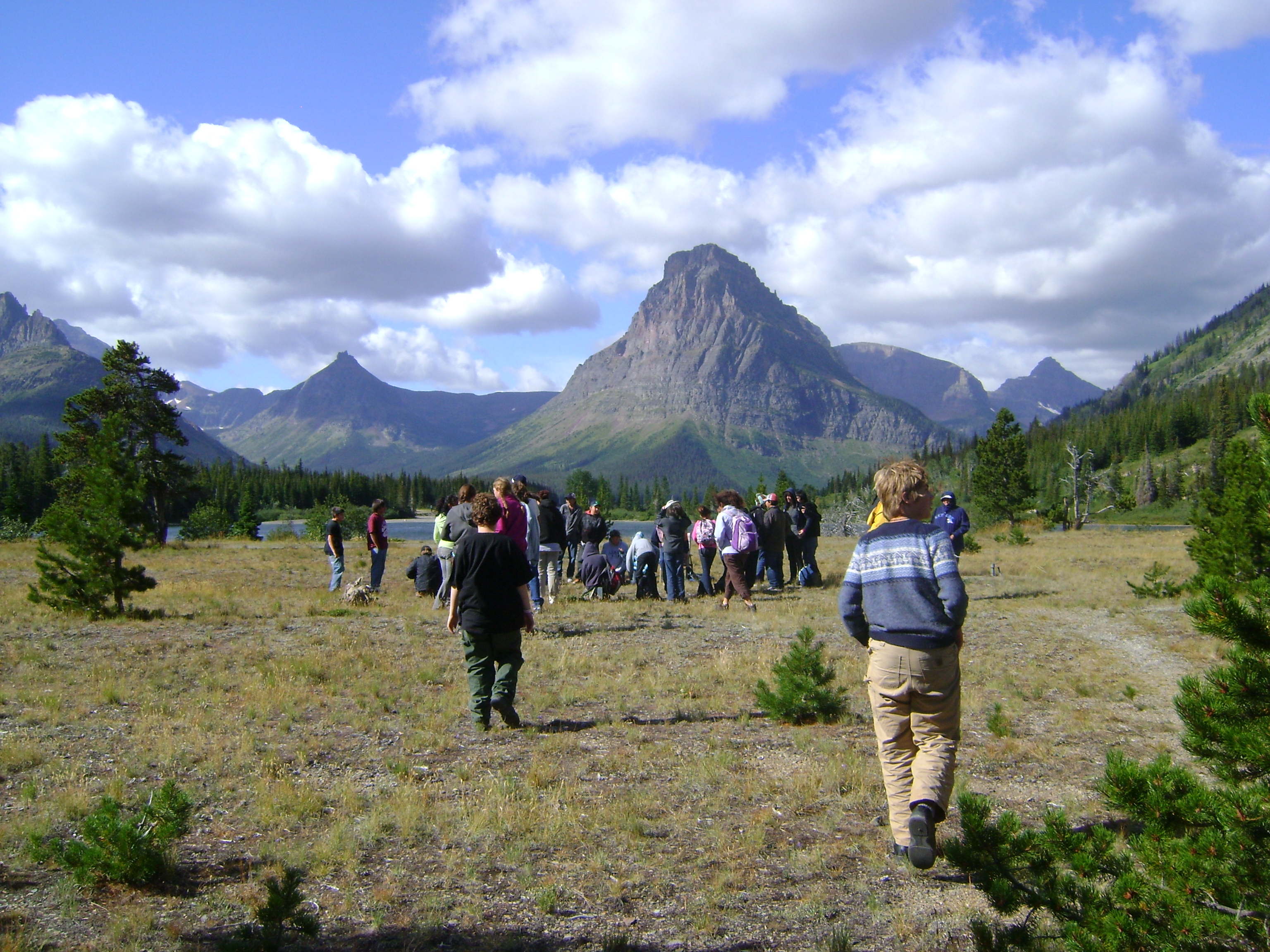
Rio Gallinas is on its tenth year and is well known for providing a unique educational opportunity where students are scientists, artists, and activists addressing community issues in hopes of finding solutions.
Rio Gallinas School of Ecology and the Arts is named after the local river which flows through the town and touches on the most important aspects of our philosophy – place-based and outdoor education, community involvement, and local history. The school culture makes education not just a priority, but a fun, integral part of everyday life by incorporating the people and activities familiar to our students while broadening their perspectives on the ever-encroaching global community at our doorsteps.
Rio Gallinas School of Ecology and the Arts serves a culturally diverse population of first through 8th grade students in the Las Vegas and surrounding areas by providing a culture of academic excellence, service, and caring, and a safe, open, and creative environment which respects each student’s abilities and honors each student’s interests. Rio Gallinas addresses these needs by providing smaller class sizes; incorporating Expeditionary Learning for thematic, project-based service-learning experiences; stressing ecological education; enhancing community involvement, and building meaningful ties with partners like the United World College, Highlands University, Luna Community College, West Las Vegas High School’s MESA Program, and local organizations like the Foster Grandparent Program. The school serves up to 125 children in first through eighth grade.
RGS is a community school that invites and inspires community and family participation. Its students contribute to the community as active citizens and participants. Parents and guardians are considered equal partners in the education of their children. Rio Gallinas School sees families as valuable resources, competent, and essential to their children’s educational experiences. Parents and guardians are welcomed and encouraged to participate in classroom and field-trip activities.
Join us where learning is a wonderful adventure!
Two local radio broadcasts about our school:
Expeditionary learning at Río Gallinas School
Director’s Welcome
I am truly honored with the fortunate opportunity to work for Rio Gallinas Charter School and serve the student, parent, teacher, and community populations. The opportunity to begin the new school year as the Director of this forward thinking school is truly a blessing. Rio’s dedicated staff of educators possess a wealth of education and experience, to contribute to the social, emotional, and academic excellence of the students.
Our community of learners is made up of outstanding students, expert and dedicated staff of caring professionals, active and involved parents and a supportive community. Together we form a strong partnership to ensure that all Rio Gallinas students receive an exceptional education. Each child is valued and encouraged to reach their full potential. The teachers are committed to nurturing and developing the ability of each child through carefully planned and innovative teaching programs.
Our partnership with the families of our students as well as other community members and organizations is a key part of our success. Students benefit as parents and guardians are involved in their formal education. The year ahead holds great potential for the academic and social development of our students, and it is vital that we combine our efforts to help them succeed. I believe that keeping the atmosphere positive is the key to success as well as keeping the lines of communication open among staff, students, and parents.
Your children are in the hands of dedicated, educated and caring teachers and staff. This will be a wonderful school year and your children will blossom into the beautiful flowers they are meant to be.
Sincerely,
Mr. Kirk Ludi
RÍO GALLINAS SCHOOL
ENROLLMENT LOTTERY POLICY

Each year the director, working with the staff, will determine the number of students to be accepted for each grade level combination. In accordance with statute (22-8B-4.1 NMSA 1978), applicants will be offered enrollment by lottery, except that preferential enrollment will be given to pupils returning to the charter school from the immediate previous year and to siblings of pupils already enrolled in the school, if such students have applied prior to the holding of the lottery. (To apply, a returning student’s parent need only affirm the intent to attend.)
A lottery will be held during the month of March. During the preceding three weeks, the school will advertise widely, giving full information about the lottery and how to apply, in such places as the local newspaper, the radio, the school website, the library, local grocery stores. In addition, the school will hold one publicly advertised enrollment information meeting at the school site during the week before the lottery. Records of advertisement, fliers, and articles will be kept on file at the school.
Families interested in their child or children attending Río Gallinas School will fill out a lottery application for each child. The application will indicate the name, grade level of the applicant, and mailing address, and optionally email and phone.
Upon the announced date of the lottery, all applications that have been received will be placed onto an entry list in an order determined by lot. This lottery process will be witnessed by the Director and one member of the Governing Council and shall be carried out in a manner to avoid the possibility of favoritism.
Vacancies in each grade level combination will be filled by offering enrollment to students in the order of their placement on the list. Within two days after the lottery, applicants will be offered enrollment, with a deadline for acceptance, or notified of their location (within grade combination) on the list. As offerees reject enrollment, or fail to reply by the deadline, additional offers of enrollment will be made from the list in order of placement.
Applications arriving after a lottery will be saved for the next lottery to be held during the year.
If at any time after the lottery there are no students on the entry list to fill the vacancies in certain grade combinations, then a lottery may be held for those grade combinations. If there are too few saved applications, the school will advertise for applications. The resulting applicants will be placed at the end of the entry list in an order determined by lot, and the vacancies filled from the list.
In order that Río Gallinas School treat the winners and losers of the lottery with equal consideration and respect, the director will develop appropriate deadlines for response to offers of enrollment and rules for initial attendance, which, if not met, will result in the offer of enrollment being withdrawn and given to the next waiting applicant. The communication offering enrollment shall clearly state this deadline and attendance requirement.
From time to time during the year, the director will review the enrollment numbers with the staff to determine if the enrollment needs of the grade combinations have changed. This review may determine vacancies to be handled as above.
The entry list shall be discarded prior to the March lottery. If still interested, applicants on that list must reapply for the following school year, and shall be given no preference.
Students entering grades Kindergarten-8th grade are eligible for Río Gallinas School.
Río Gallinas School will not discriminate based on ethnicity, religion, gender, economic status, disabilities, and limiting conditions. Río Gallinas School will not charge tuition or have admission requirements, except as otherwise provided in the Public School Code.
Approved by Río Gallinas School Governing Council 28 September 2011
Our curriculum follows the framework of Expeditionary Learning and Arts Integration, incorporating the Common Core State Standards. Students from Rio Gallinas School are equipped with the latest technology to recored, report, and share their unique eduction as they discover the world.
RGS students spend as much time on classwork and homework as their counterparts at other local public schools, but we combine this challenging curriculum with a wealth of educational adventures in our city, its surroundings, and in/out of New Mexico. These unique enrichment opportunities bring textbook concepts to life by facilitating meaningful exchanges with teachers, peers, experts, and locals guides.
Our students are encouraged to think for themselves, speak up, and take responsibility for their actions. Our students will enter the next pause of their high school life as open-minded and empathic young adults who can make good choices for themselves, the community, and the environment.
Expeditionary Learning
 What is Expeditionary Learning?
Expeditionary Learning is a model for comprehensive school reform for elementary, middle, and high schools that emphasizes high achievement through active learning, character growth, and teamwork.
As Outward Bound aims at personal transformation, Expeditionary Learning aims at the transformation of whole schools. Both work at challenging and helping people do more than they would have thought possible. Both view learning as an act of discovery, and experience as the most potent teacher. They are based on certain ideas about what is important for a person to learn and practice as a foundation for academic success and success in life, such things as enterprise, resilience, curiosity, tenacity, self-discipline, teamwork and compassion.
Core Practices
 Expeditionary Learning emphasizes five Core Practices within its schools:
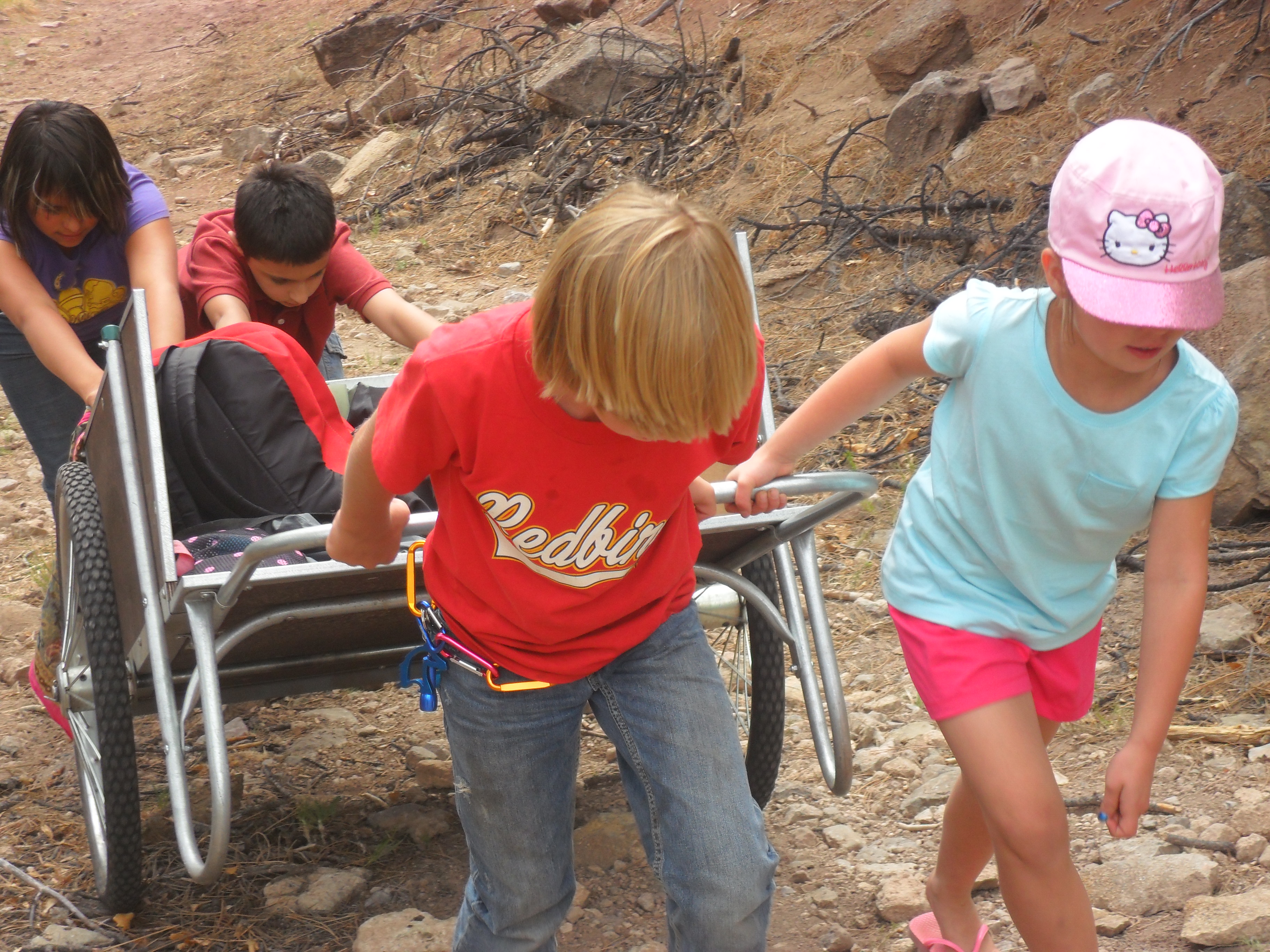
• Learning Expeditions: These challenging, interdisciplinary, real-world projects and in-depth studies act as the primary curriculum units in Expeditionary Learning schools. Learning Expeditions support critical literacy and address central academic standards of content, while promoting character development and fostering a service ethic.
• Active Pedagogy: In Expeditionary Learning schools, teachers use active pedagogy to help students become active and collaborative learners: to make connections, to find patterns, to see events from different perspectives, to experiment, to go beyond the information given, and to develop empathy and compassion for events, people, and subjects.
• School Culture and Character: Expeditionary Learning builds shared beliefs, traditions, and rituals in order to create a school culture, which is characterized by a climate of physical and emotional safety, a sense of adventure, an ethic of service and responsibility, and a commitment to high quality work.
• Leadership and School Improvement: Leaders in Expeditionary Learning schools create a professional community that focuses on curriculum and instruction as the primary vehicles for improving student achievement and school culture.
• School Structures: Expeditionary Learning schools use longer and more flexible schedule blocks, common planning time, heterogeneous groupings, and/or looping to ensure student success. Expeditionary Learning achieves success in these Core Practice areas by providing schools with an extensive professional development program. Over a multi-year period, school faculties and administrators are offered a coherent, demanding, and highly regarded program of professional development to implement the model and to realize significant improvement in student learning and character development.
Design Principles
10 Design Principles
2. PRIMACY OF SELF-DISCOVERY Learning occurs when students are engaged in meaningful activities that require their whole selves. They discover their abilities, values, passions, and responsibilities in situations that offer adventure and the unexpected. As part of ELOB, students participate in expeditions that require perseverance, fitness, craftsmanship, imagination, self-discipline, and significant achievement. SNACS educators help students overcome their fears and discover they can do more than they think they can.
2. THE HAVING OF WONDERFUL IDEAS All children possess a natural curiosity about the world we live in. Teachers design learning experiences where children can investigate, experiment, and pursue a hands-on exploration that enhances what they learned during direct instruction.
3. THE RESPONSIBILITY FOR LEARNING Learning is both a personal process of discovery and a social activity. Everyone learns both individually and as part of a group. The SNACS culture promotes life-long learning for children and adults while encouraging everyone to become responsible for directing their own personal and collective learning.
4. EMPATHY AND CARING Learning is fostered in communities where there is mutual respected between and among adults and students. Learning groups are small with a caring adult looking after student progress and acts as an advocate for each child. Older students mentor younger ones, and students feel physically and emotionally safe.
5. SUCCESS AND FAILURE All students need to be successful to build confidence and the capacity to take risks and meet increasingly difficult challenges. But it is also important for students to learn from their failures, to persevere when things are hard, and to learn to turn disabilities into opportunities. Every opportunity of misbehavior or failing to meet mastery is an opportunity to learn the appropriate behavior or skill.
6. COLLABORATION AND COMPETITION Individualized and group learning are integrated so that the value of friendship, trust, and personal growth is clear. Students are encouraged to compete not against each other, but with their own personal best and with rigorous standards of excellence.
7. DIVERSITY AND INCLUSION Both diversity and inclusion increase the richness of ideas, creative power, problem-solving ability, and respect for others. SNACS students investigate and value their different histories and talents as well as those of other communities and cultures.
8. THE NATURAL WORLD The natural world refreshes the human spirit and teaches important ideas of recurring cycles and cause and effect. Outdoor lab experiences are crucial to SNACS philosophy. Students learn to become stewards of the earth and of future generations.
9. SOLITUDE AND REFLECTION Students and teachers need time alone to explore their own thoughts, make their own connections, and create their own ideas. They also need time to exchange their reflections with other students and with adults.
10. SERVICE AND COMPASSION We are crew, not passengers. Students and teachers are strengthened by acts of consequential service to others. One of ELOB primary functions in design is to prepare students with the attitudes and skills to learn from and be of service.
More information can be found about ELOB by visiting the website at www.ELOB.org.
Heart Butte Trip
Tuesday, August twenty-fourth, 2010
Hello all!
Greetings from I-25 in Wyoming. We camped last night at Glendo State Park, a spacious place beside a reservoir, where we ate a lovely meal provided by Ado Lujan, Maricela’s mom, owner of Estella’s. It was so great to simply heat up what was already pre-cooked for us, without worrying too much our first night! Chicken and pasta salad! We went on an evening walk as the moon rose and the sun set. We all took time to be silent and write for about fifteen minutes and afterward, some students shared their thoughts with the rest of the group. We were all quiet and in our tents at about 9:30 PM and we snuggled down into our sleeping bags for the night
This morning, we rose to greet a gorgeous morning of sunny skies and crisp, fresh air at about 6:00 AM. Everyone soon began break down their camping spots, stowing away sleeping bags and tents for later. A student/staff team cooked the potatoes and eggs for breakfast burritos and we all ate until we were satisfied. After breakfast, we all did a math lesson and before boarding the bus, Eliza McLeod led us in a fun movement game called Button Factory to get our blood pumping.
We planned on going to the historic battle site of Little Big Horn, but an unfortunate incident prevented us from getting there. Two tires on our chuck wagon, driven by Chris Ruge, at two different times, went flat. The visit to Little Big Horn would have taken too long and we would not have made it to our next camping destination, Kings Hill, by dark. So it was another long day on the bus, but we are keeping our positive mental attitude! Passed many oil rigs and giant power plants. Tomorrow we will be in Heart Butte and there will be more news!
Until tomorrow,
Corrine and John
Wednesday August twenty-fifth, 2010
Arrived at dusk to our camp site. Two deer romping where our tents would be. Tents up and fire warmed last night’s chicken and cold tortillas. Cool morning in ponderosa meadow. Warming hot oatmeal got us in gear as we pushed to get on the road to meet Heart Butte deadline of 1:00. Landscape was what appeared to be giant wheat fields with Dune looking giant machines creating clouds of dust as they gathered in our nation’s food staff.
We met Frosty Boss Ribs, our friend from Heart Butte School, and we got a tour of their elementary and high schools–both of which are in the same building. We ate lunch and set out on the road for Browning, MT, en route to the Plains Indian Museum. Every student drew at least one item in detail and brought historic and cultural facts to the campfire later that night.
After the museum, Frosty escorted our caravan to the Chewing Black Bones campground. Unbelievable. You have to see it. You will, when you look at our pictures. This will be our home for the next four nights. We have tons of flat land to play on, a cold glacier lake to swim in, and hot showers when we want them.
Until tomorrow,
Corrine and John
Thursday, August twenty-sixth, 2010
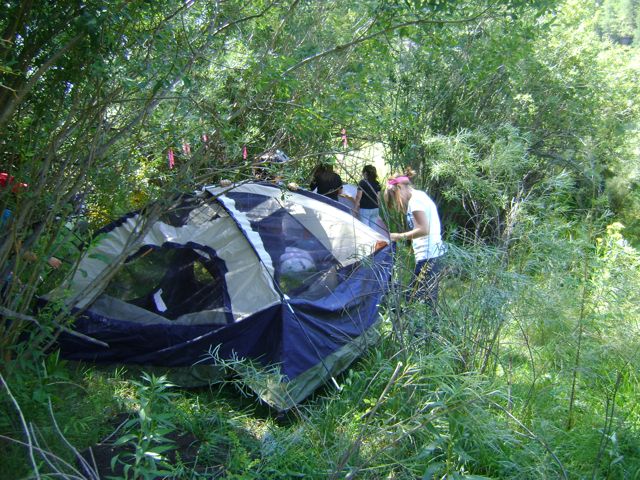
This morning, we began the morning by writing New Mexico post cards to our friends from Heart Butte.  They met us at our campground with breakfast and lunch bags in hand at about 9 AM and we handed them our hand-written notes. We had an introduction circle and we split up into our two busses to mingle and reacquaint ourselves. We drove to Logan’s Pass inside Glacier National Park to eat lunch and hike. Our hike up Hidden Lake Nature Trail was about 1.5 miles through the beautiful mountain vistas. Mountain goats were along the trail almost close enough to touch and big-horn sheep were grazing in a herd below us when we reached the summit. The lake below was huge and greenish in hue. We would have loved to hike down to the lake but it was a very steep incline and time did not allow for such an extensive trek. Back at camp, some of us swam in the cool water and we met a group of Hutterite youth picking huckleberries and having a swim. After our long day of physical activity, we ate a delicious dinner and climbed in our tents early to avoid getting wet from the slight sprinkling rain. There was a little thunder, a little lightning, but we all slept soundly.
Until tomorrow,
Corrine and John
Friday, August twenty-seventh, 2010
We woke this morning to a chill in the air. Today we needed all of our layers to begin the day. We drove to meet Frosty and her crew in Browning and headed into the park. Our second day in Glacier National Park began at Running Eagle Falls, formerly known as Trick Falls. Again, we wer e with our friends from Heart Butte, climbing the cliffs around the falls. Chris Cudia, Lucas’s dad and our expert scientist, was with us to help us understand glaciers and how the landscape we were walking in and around was formed. We challenged Heart Butte School to a rematch of their native gambling game with the “bones.” One team hides the bones and the other guesses which hands the plain white bones are in. Hand signals are used to guess. For every correct guess, the team earns a painted stick. When all the sticks are on one side, the game is over. Last time, at Story Ranch, they won, no contest. Of course, we had never played before. This time we gave them a little more of a challenge and the result is still disputed–did we win or lose?
After the game, we went to Two Medicine Lake where we all boarded a ferry. From the boat, we saw a 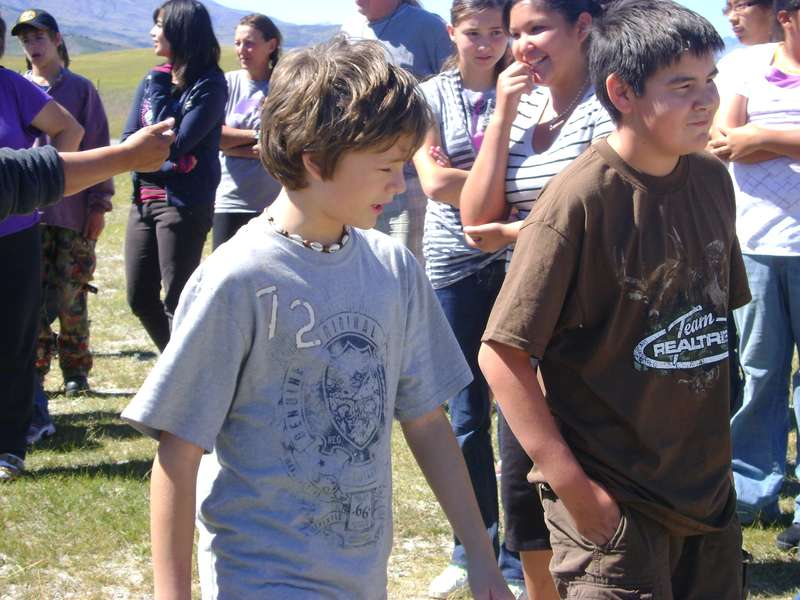 black bear cub romping around on the lake shore! We docked at the other side of Two Medicine Lake and walked the nature trail to more glorious waterfalls. At the water’s edge, some of us looked under rocks in the water to find what was living beneath. We found the larvae of Caddis Flies, May Flies and Stone Flies. Chris told us that those species were signs of a very healthy ecosystem because some of them, namely Stone Flies, cannot survive in even the smallest amounts of pollution. Those who weren’t examining the animal life in the water hiked up to the top of the falls. We saw where those falls originated and split into two. When we arrived at the dock again, our ferry was arriving and we headed back to the bus. Dinner will be spaghetti and we will write by the fire side and tomorrow will begin a bit easier with a less stringent schedule.

Until tomorrow,
Corrine and John
Saturday, August twenty-eighth 2010
This morning the air was cool, but the sun was shining so we knew it would warm up. We started the day slowly today and some of us slept in. The breakfast crew picked wild huckleberries and we ate a breakfast of scrumptious berry pancakes! We took our time to get ready and at about noon we loaded the bus and took a short drive–to Canada!! The Canadian border patrol was kind and let us walk to take pictures on the Canadian side. They said we did not pose a security threat, and one officer joked with her fellow officers in her walkie-talkie that we all wanted to claim “refugee status.” After our group photos we took another short drive to the Swift Current River to study water quality with Chris. This time we all saw aquatic critters that had been caught in a net by Lucas and his dad. We had lunch by the river and went back to camp for an afternoon of reading and playing and packing. The rain was light all afternoon and evening, but we had our rain gear and tarps to cook and eat under, so we all stayed dry. S’mores after dinner were a delight and then we brushed our teeth before we had a…TALENT SHOW!! There is so much talent in this group! We saw comedy, singing, poetry and dance. So much fun! We were lulled to sleep by raindrops on our tent tops.
Until tomorrow,
Corrine and John
Sunday, August twenty-ninth 2010
This rainy weather did not make it easy or comfortable to pack up a campsite, but we did great! Everyone pitched in and despite cold hands and wet knees, we were on the road by 8 AM. We are on our way to Yellowstone. It will be a long day of travel on the bus and the weather may be chilly and damp. We shall see what we shall see.
Until later,
Corrine and John
Tuesday, August thirty-first 2010
Yesterday, Monday, we slept in a bit before heading out to Old Faithful and a geyser field where it smelled slightly of boiling eggs and the steam rolled all around us. We arrived within ten minutes of Old Faithful’s eruption and then walked the loops to examine other types of geysers in the area. We learned that there are only 1000 geysers on the entire planet and Yellowstone has over half of them! We walked around inside the Old Faithful Inn which is a hotel, restaurant and gift shop built at the turn of the century, completed in 1904. The woodwork inside is absolutely incredible. We saw 4 otters swimming in Yellowstone Lake. Traffic stops for herds of bison and elk. We have seen mule deer, too. Still no bears!! Even though it was cold and rainy back at camp, we told stories by the campfire, ate hot stew for dinner and slept (mostly) warm.
This morning, Tuesday, we woke to even chillier conditions. There was frost. Our tents were snowy before we left camp. We bundled into the warm bus and set off to the north. We visited a tree petrified by mudslides through volcanic activity. We ate pizza and homemade ice cream in Gardiner, MT, north of the park at a restaurant called Outlaw Pizza. We just came from where the Boiling River meets the Gardiner River–it is a mixture of very hot 180 degree water with the 50 degree water of the Gardiner River. We basked there under sunny skies (yes, the weather HAS changed!) for over an hour. We are stopping here to send this email before heading back to camp for dinner and relaxation. We apologize for not sending emails earlier, but there has not been a single opportunity.
We will be home soon!
Corrine and John
Rio Gallinas School for Ecology and the Arts
Students Take Learning On the Road
It was twelve days, thirty-three hundred miles, two countries, three National Parks, and a visit with their pen pals at the Blackfoot reservation in Heart Butte, Montana.
For twenty-five seventh and eighth grade students at Rio Gallinas School for Ecology and the Arts, an on the road trip was a remarkable way to start the new school year. “I‘ve had one of the greatest times of my life, and I learned a lot,” wrote seventh grader Lexi Perea-Angles, “Along the way we created really strong bonds.”
The previous summer, John McLeod, 7th grade teacher at Rio Gallinas School was contacted by a group called Bridging which was established to develop writing relationships between students in two schools, Heart Butte in Montana and Rio Gallinas, In January of 2010, the exchange of letters began. In April, eight ‘student ambassadors’ and two staff members from Heart Butte paid a weeklong visit to Las Vegas that culminated in a joint trip to the Gathering of Nations Pow Wow in Albuquerque. As they departed, the Blackfeet students extended an invitation to visit them in Montana.
Over the summer, students, staff and family members raised funds for the trip through selling raffle tickets, writing grants and approaching local individuals, businesses and organizations. “Thanks to generous support by First Community Bank, the Eagles, the Kiwanis, Estella’s, Rio Gallinas parents and students and others, the needed funds for the trip were raised,” reported parent and Amigos de Rio Gallinas organizer Anna Ortega.
Meeting and getting to know Blackfeet pen pals had been a central reason for the trip, as well as having a chance for a rematch in a traditional Native gambling game using bones and sticks. Although defeated in April on home ground, the Rio Gallinas students were eager to face their friends. With cold winds blowing, along a lakefront, and below a magnificent mountain range in Glacier National Park, Rio Gallinas School challenged their archrivals, the Blackfeet. Although the game was close, it finally ended with the Blackfeet edging out their visitors from down south.
“You would be hard pressed to develop a more rich earth science and cross cultural experience than this trip,” stated 7th grade teacher John McLeod, “ It was one of the most profound educational experience I have had the pleasure to participate in.”
As an Expeditionary Learning School, Rio Gallinas prides itself in offering compelling, real world experiences that fold in hands-on experiences with academic learning. Water quality scientist for New Mexico Environment Department, Chris Cudia, caught up with the group at the Blackfeet tribe’s Chewing Black Bones Campground adjacent to Glacier National Park. He recently said, “Teaching science in the outdoor laboratory is real teaching where science really happens. It is the most fulfilling place to learn for teacher and student.”
With Canada only miles away, the group unanimously voted to visit their northern neighbors. Although the excursion was but a stroll across the border, the students experienced the goodwill of the Canadian border officials who generously allowed the international foray.
Leaving the Blackfeet friends at Two Medicine Lakes, after watching a teen black bear romp along the shoreline, the group headed south to the second national park, Yellowstone. It was the geysers that most caught the imagination of the students. “Did you know that half of the world’s geysers are in Yellowstone?” asked 8th grade student Jaibo Bailey, “That’s five hundred of them.”
While camping in Yellowstone National Park, students woke to find some tent zippers frozen and snow gathering on the ground. Southern entrances to the park were closed due to the ice and snowstorm that had blanketed the region. Eighth grader Kayleen Bessman recalled, “ I woke up to the sound of raindrops and snow clumps. It was pretty cold.”
“Moving students out of their comfort zone is one of the tenets of Expeditionary Learning. It has its application on not only wilderness trips but in the classroom setting where we push students to stretch their skills and minds,” said eighth grade teacher, Corrine Sieser.
While visiting Rocky Mountain National Park, students were greeted with two bear cubs frolicking in the woods. “The wildlife we saw was unbelievable. I loved the land there,” said seventh grader Daniel Vigil.
“ I support this approach to education because I see that when you mix knowledge with experience something great grows out of that. I see students wise beyond their years,” continued Chris Cudia.
The upper school’s current expedition is titled ‘Crafting a Renaissance’. In looking 500 years in the past, they are studying the role arts and sciences played in moving Europe out of their Dark Ages.
The students hope to raise sufficient funds from sales of handmade products from their guilds, and perhaps another raffle, to fund a visit to a national Renaissance Fair in Arizona in March. Rio Gallinas School for Ecology and the Arts, in its seventh year, is a free public charter school serving grades first-eighth. For further information you may call 505-454-8687
FAQ
FREQUENTLY ASKED QUESTIONS ABOUT EXPEDITIONARY LEARNING
1. What is special about Expeditionary Learning??a joint emphasis on character and academics;?the quality, coherence and relevance of its program of professional development;?a sense of moral purpose;?its sustained work and continuing relationship with a growing system of improving schools around the country;?that it breathes life into a standards-based curriculum
2. How does EL work with a school??by providing professional development and technical assistance over a period of years to improve instruction, school culture and student achievement.
3. How is Expeditionary Learning connected to Outward Bound??it was developed by Outward Bound USA, and draws upon the educational and developmental ideas of Outward Bound’s founder, Kurt Hahn, and Outward Bound’s significant history of teaching through adventure and service. Expeditionary Learning has its own nonprofit 501(c)3 status, but operates in close concert with other Outward Bound entities in the US and around the world.
4. How do you ensure the quality of your services??We employ excellent people and give them wonderful work to do. And we monitor and review the quality of our services and their impact in each partner school every year.
5. What is the background of the EL staff we will work with??Most have extensive successful experience teaching and administering in public schools. Many also have had successful experience leading and teaching in the outdoors and other experiential venues.
6. Is Expeditionary Learning researched based??Yes. The principles and practices underlying Expeditionary Learning are supported by a significant research base and Expeditionary Learning’s program has established one of the most positive track records of any school improvement effort begun within the past fifteen years.
7. How do we have time to “do EL” and also teach to the standards??”Doing EL” is the most effective way of teaching to the standards, because it leads teachers to understand the standards and figure out how best to engage students in reaching them.
8. How much time will be needed to commit to implementing Expeditionary Learning??All teachers should expect to spend at least twelve to fifteen days a year in Expeditionary Learning-related professional development. Principals and other school leaders should do more than this. But since there should be no difference between implementing Expeditionary Learning and doing school as well as you can, it really is a full-time job.
9. What can we expect to do in the summer with Expeditionary Learning??There will be summer institutes for the entire faculties and leadership of from one to two weeks in length, and a third or more of the faculty each year are expected to participate in one or more additional week-long summits, institutes, or Outward Bound expeditions.
10. What sort of regional opportunities are there with the design??There are periodic meetings of EL principals and other school leaders within a region, regional reading, writing, math and science institutes and the like.
11. Is Expeditionary Learning just one more thing we need to add on??No. It should provide the basic structures, principles and practices used in your school.
12. How does a school know that it is implementing the design well??There are clear benchmarks against which a school may assess itself, and Expeditionary Learning does a review with every school in its network each year.
13. What does Expeditionary Learning do to help start a new school??In partnership with school districts, regional educational authorities, and organizations that hold or are seeking charters, EL may help to plan the school, secure a charter for a school, find funding for the school, and find leadership and faculty for the school. How much EL does is in each case is usually dependent on the nature and history of the partnership.
14. How does Expeditionary Learning work with high schools??Just as it works with elementary and middle schools, by working intensively with school faculty and leadership to improve instruction, school culture and academic achievement. There is more emphasis on preparation for college, and on the demands of specific academic disciplines.
15. How does instruction change in an EL school??It implies high expectations for all students. It becomes more active, more engaging, and more individualized. It makes more use of teams and group support. It’s more connected to the real world.
16. How do you help teachers integrate state standards into teaching??Very often by having them determine what the most important standards are, and then helping them work backwards from these standards to think through how compellingly they might be experienced and taught.
17. How do EL teachers prepare students for standardized tests??First, they lead their students to learn as deeply and well as they can the things that are most important for them to know. They try to understand the tests have to take and what it is they are testing. If there are testing modes that are likely to be unfamiliar to their students they prepare them to understand and deal with them.
18. What if a school has a reading or math program that is required by the district??It may or may not be possible, depending on the programs, to sufficiently integrate them into Expeditionary Learning’s approach to curriculum and instruction. Answering the question involves looking more closely at the nature and requirements of the required programs.
19. How does Expeditionary Learning address literacy??As the most central set of skills for learning teachers and students must have. The relentless teaching of reading and writing, speaking and listening are integrated throughout the entire curriculum.
20. How is a learning expedition different from a theme??A learning expedition is a form for actively and deeply learning important things, of having an experience of them: in some instances, a theme, or central question can serve as a starting point for a learning expedition.
21. Are service, adventure and fieldwork a part of every learning expedition??Yes. But think of service and adventure primarily as qualities rather than primarily as program components. Not all learning expeditions should necessarily have service components, though for some learning expeditions a service project will provide the most compelling reason to undertake the expedition. But a sense of service, a habit of mind in which students naturally seek and find opportunities for helping others, should be a part of each learning expedition just as it should be part of the school culture. The same is true of adventure. There should be a sense of adventure in every expedition, a sense of venturing into new territory. This adventure is intellectual as well as physical or social. Fieldwork is getting out into the field to do research, and it should be a part of every learning expedition.
22. Does Expeditionary Learning meet all 11 criteria for CSR? ?Yes. Click here for a link to the 11 criteria.
23. Can I visit an Expeditionary Learning school??Yes. There are site seminars scheduled at several schools every year just for this purpose. Alternatively, you should schedule a visit to a school like yours by getting in touch with one of our regional directors.
Bordering on Ethics
by John McLeod
Where would you take students in order to immerse them in the theme of The Ethics of Eating? Where would you go to get students to start asking important questions of how what we eat effects not only our bodies, but also the environment, other people and other nations? As is the case with each new learning expedition that Rio Gallinas Charter School undertakes, the immersion into the expedition theme demands careful planning and creative thinking.
“We looked south to issues of migrant workers, Fair Trade, … displaced agricultural workers, and the increasingly difficult border crossings that so many Central Americans attempt in order to come to this country for work in the food industries,” said 8th grade teacher Corrine Sieser.
For five days, 21 sixth through eighth graders, parents and staff traveled to Agua Prieta, Mexico to experience firsthand some of the ethical issues tied to agriculture that face people living on the border. The experience was modeled on the United World College’s trips to the area where an organization called Frontera de Cristo provides visitors with experiential insights into critical realities facing residents of the sister city near Douglas, Arizona.
Home base was a community center in the heart of a neighborhood on the east side of the city. Families, even those living in homes under construction and with pallets as the main wall structures, still provided several meals for the students. Following the meals, they shared stories of being economically forced off their land where they grew coffee or corn and coming to the border in hopes of finding work in the maquilas (factories) or maybe to gain a rare and precious visa to work across the border. “It was amazing how people in the small homes that looked like they had nothing would give so generously, as though they had everything,” said 7th grader Cisco Cordova.
The border was ever present as the group traveled. Among the places they visited was a recently developed Permaculture Center, a migrant workers’ shelter, a self-supporting drug and rehab
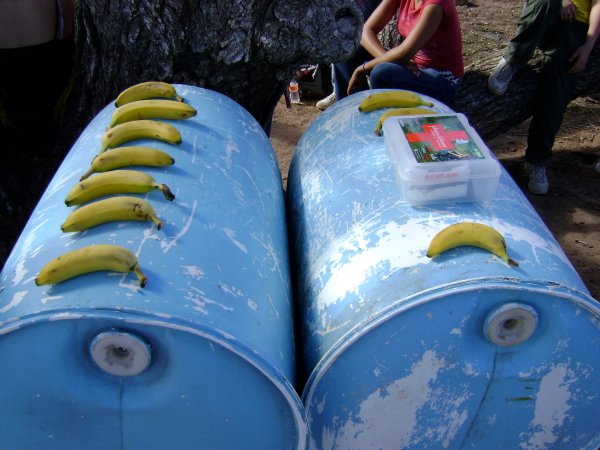
Water for border-crossers
center, and a Fair Trade Coffee Cooperative. One outing took the group deep into the desert with a group called Agua de Vida. Run by members of CRREDE, the Drug and Alcohol Rehab Center, these men refill barrels with water each week to try to prevent deaths due to dehydration of people attempting to enter the USA illegally.
“I thought it was cool that they were more concerned with people living than the illegal migrant worker issue. They just did not want them to die,” said 8th grader Osha Bailey.
They found out that as the border tightened, people have been pushed further into the desert to try to cross into the United States. Students were told that close to four thousand people have died trying to cross the border.
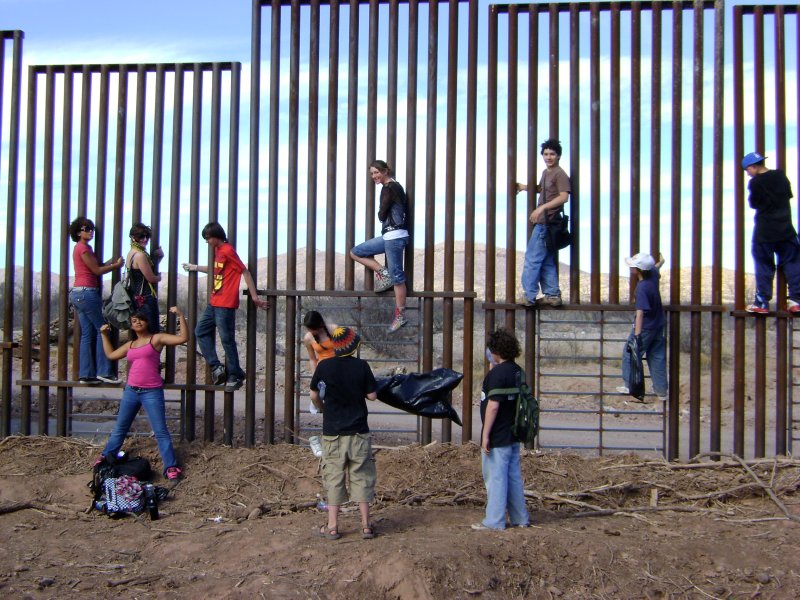
US-Mexico border fence
“As I put my arm through the border wall it was no different being in two countries at once and it made me think why people are so against immigration,” mused 8th grader Molly Cudia.
In order to keep families together, there has been an increase in women and children attempting the border crossing. After walking a remote desert trail to the 20-foot metal border, 6th grader Alexis Vigil said, “I think that families should be able to make it across the border freely so they can work like normal people.”
Some of the families interviewed had left their farm lives in southern Mexico to seek jobs in the factories that have grown along the border since the early 1960’s. Such jobs are now increasingly tight as many of the factories have moved south or to other countries where labor is cheaper. Current wages for factory workers are $60-$90 for a full week’s work. One related experience the group had was to purchase and cook a meal based upon a maquila worker salary. Their budget needed to take into account minimal rent, some utilities, and school fees. “It was pretty hard to buy enough food to feed the group. We had to keep putting stuff back,” said 8th grader Eliza McLeod.
The week also brought students to Just Coffee, a Fair Trade cooperative that now supports 58 families in Chiapas, Mexico. By roasting and packaging their own coffee and selling directly to customers, this group has established a business that not only pays the growers higher prices for their coffee beans, but also assures organic growing methods free from toxic pesticides. Proceeds from the sale of the coffee also assist retirement plans for the growers and 10% of profits are returned to the growers’ community to help with infrastructure improvement.
Marisa Romero, 8th grader said, “It was interesting how they roasted the coffee beans. The people who grow the coffee work really hard and they should be rewarded more than they usually are.”
A highlight of the trip was a two hour improvised USA / Mexico soccer match with neighborhood young people. Perhaps ‘match’ was not the right word to describe what turned out to be a mismatch with the USA team struggling to compete with a much more skilled Mexican team. “There’s always next time,” said 6th grader Maricela Lujan.
Hear a radio discussion of the trip (48 min):
Immersion: Las Gorras Blancas
by John McLeod
It was on the second night when they came. Three riders, with white sacks over their heads to protect their identity, rode down the steep trail from the high country. The meeting was secret and held in the mountains adjacent to the village of Gallinas at the base of the ridges along the Rio Gallinas. It was 1890 and Las Gorras Blancas, the White Caps, were there to convince others of the need to resist 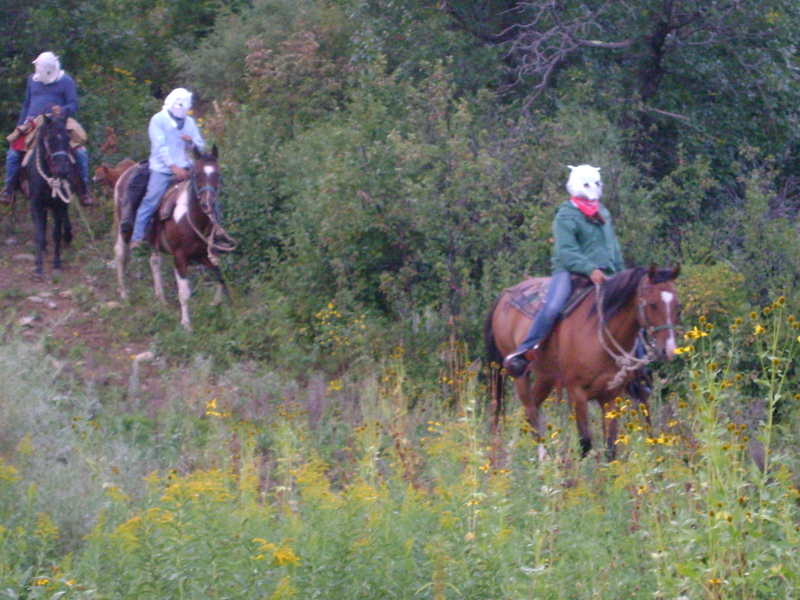 the break up of the Commons, land that had been guaranteed under the Treaty of Guadalupe Hildago in 1848. Membership in the highly secretive movement grew to over 1,500.
Sixty students from Rio Gallinas Charter School’s fifth through eighth grades of Rio Gallinas School initiated its fall immersion experience by reenacting an important local story of highly organized resistance to land thievery that took place in our region in the late 1800’s.
“When I was accused of being a member of the Gorras Blancas, I felt surprised and wanted to defend myself,” said eighth grader Cisco Cordova, “ I think I would definitely have fought the break up of the Commons if I had been alive then.”
Used as a case study for investigations of nonviolent resistance to injustice, the historical play acting leads into the school’s expedition titled Choose Your Weapon: Stories of Nonviolent Struggles.
Aerie Maymudes, sixth grade teacher added, “Our fifth and sixth grade students will devote much of our fall studies to research three brothers in the Herrera family of San Geronimo who led the resistance through both illegal and political means. Although the numbers of armed Las Gorras Blancas was in the hundreds, their choice of weapon to fight the stealing of land was limited primarily to destruction of the fences that were cutting off the community’s lifeblood, the Commons. We will be searching for any stories or artifacts of Las Gorras Blancas activities.”
Meanwhile, the 7th and 8th graders will be teaming with United World College students and the Bartos Institute for the Constructive Engagement of Conflict to collect stories of nonviolent struggles from around the world. These stories will be highlighted through the development of an Encyclopedia of Nonviolent Weaponry.
“The emphasis of this expedition is to expose our students, the United World College students and the community to the power and methodologies of nonviolent resistance worldwide,” said John McLeod, 7th grade teacher. “We are currently planning a regional conference on Martin Luther King’s Day in January to honor and celebrate the historical and contemporary uses of nonviolent action in conflict situations.”
The student’s work is being developed in association with Dr. Gene Sharp of the Albert Einstein Institute. With close to two hundred strategies identified, the institute is dedicated to the research and education of the history, power, and methodologies of nonviolent struggle. The stories collected from this expedition will be understood within the larger framework of Sharp’s work.
Rio Gallinas Charter School is a public first through eighth grade with an emphasis upon Arts and Ecology. As one of one hundred and sixty Expeditionary Learning schools in the United States and Puerto Rico, Rio Gallinas structures their curriculum around long-term thematic investigations. Other topics this fall are Horses as Service Animals and Learning From Chimps. This is the school’s sixth year.
Arts Integration
 WHAT IS INTEGRATED ARTS EDUCATION?
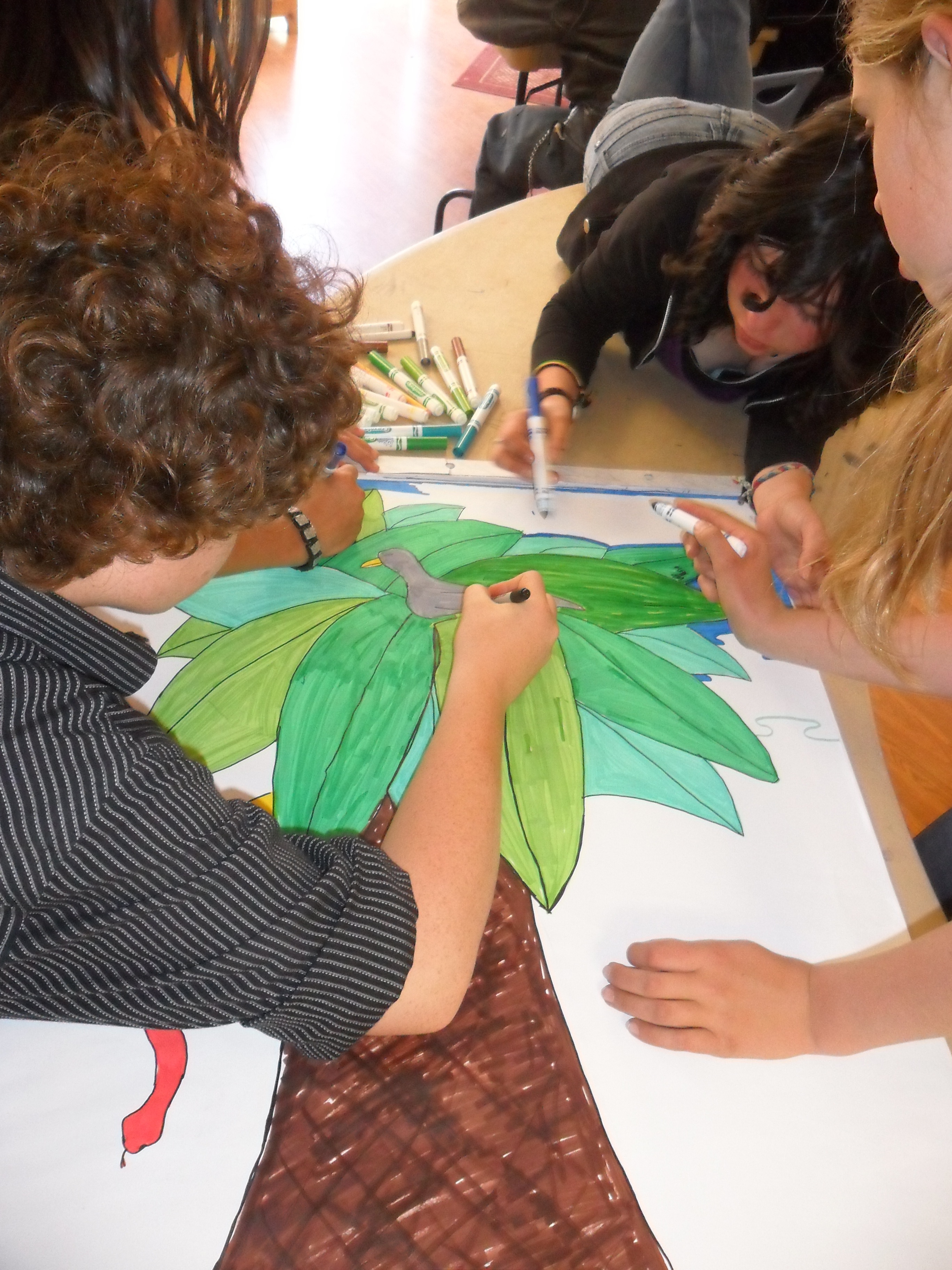
Arts Integrated Instruction has become an area of great interest over the past decade as schools across the country are discovering the power of the arts when used as a catalyst for teaching across the curriculum. Arts integration refers to teaching and learning that uses fine and performing arts instruction in two or more subject areas as a primary means of learning. The purpose of this type of integrated instruction is to help students gain a deep understanding of an important concept that is common to all the subjects involved. The John F. Kennedy Center defines arts integration as “an approach to teaching in which students construct and demonstrate understanding through an art form. Students engage in a creative process which connects an art form and another subject and meets evolving objectives in both.” By combining knowledge and thinking in different disciplines, students learn to apply knowledge learned in one area to challenges in another area—a skill that will serve them well—both in school and in real life. Arts integration means that the arts (dance, music, theatre and visual art) constitute one or more of the integrated subject areas. Arts integration is not a substitute for teaching the arts as separate subjects. Rather it complements traditional arts instruction and helps to affirm the relevance of the arts in the school curriculum.